




$78.49In stock, ships tomorrow
Free shipping on orders over $20010% off with code WELCOME
Shop other styles
1 products
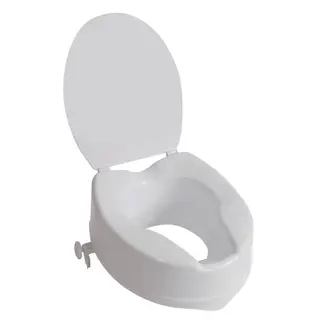
Setting up the bathroom and the toilet is the first step in preventing accidents at home. A raised toilet seat is a daily living aid meant to lower fall risk when someone sits down or stands up at the toilet. The goal is a seat height that asks for less range of motion. To lower fall risk even more, raised toilet seats with armrests include 2 handles so the user has something to push on when sitting and/or standing.
This kind of orthopedic and ergonomic equipment is genuinely reassuring. Support bars built into the raised seat mean you do not have to drill the bathroom walls to install wall grab bars. Support is on both sides, so body weight is shared evenly across both arms when you push to stand.
Standing up from a low seat takes considerable strength in the legs (quadriceps) and puts heavy demand on the joints (hips, knees). Adding a raised seat lets you:
Installing a raised toilet seat with handles is not only about comfort. It is often a medical need that occupational therapists recommend in many clinical situations.
After a total hip replacement, bending the operated leg past 90 degrees is strictly off limits (dislocation). A raised seat keeps a safer, more open angle, while the armrests give a firm hold so you can lower yourself gently without forcing the new joint.
For people with severe osteoarthritis, inflammatory rheumatism, or osteoporosis, going to the toilet can be dreaded because of pain. Pushing with the hands takes load off the lower spine and the legs. People with Parkinson's disease, or who have had a stroke, also use the armrests as steady spatial landmarks.
Choose the equipment based on clear criteria, tied both to the user's build and to the layout of the bathroom. If you need help choosing your raised toilet seat with armrests, read our buying guide.
The ideal height lets the user sit with both feet flat on the floor and the knees at an angle slightly greater than 90 degrees. Three standard sizes are available:
Safety depends on how stable the device is. Models usually attach directly to the ceramic of the bowl. Some replace the existing seat entirely and screw on, which gives the best possible stability. Others clip on or use side knobs for a tool-free install, a strong fit for travel or a quick setup.
The arms on the raised seat matter a great deal, depending on how independent the user is and how they get around:
| Armrest type | Main benefits | Best user profile |
|---|---|---|
| Fixed armrests | Maximum stability of two-sided support, a stronger sense of safety ("cocoon" effect). | People who walk but have balance trouble, after surgery, overall muscle weakness. |
| Flip-up / drop armrests | Allows a sliding transfer, makes body cleaning easier for a caregiver, saves a modest amount of space. | Wheelchair users, people with hemiplegia, help needed at the toilet. |
| Asymmetric armrests (only 1 flips up) | Fits very narrow toilets or toilets set against a wall, and a one-sided transfer is possible. | Tight bathrooms, patients who can use only one side of the body. |
Intimate hygiene equipment has to be designed with care. Most of our raised seats with support bars are made of high-density plastic (polypropylene or ABS). These materials are non-porous and treated to resist stains and odors and to make disinfection easier.
Some models have an anatomical opening at the front and the back. That cutout is there to make personal hygiene easier without forcing the user to stand up too soon, which further lowers the chance of losing balance.