



From$77.49In stock, ships tomorrow
Free shipping on orders over $20010% off with code WELCOME
Shop other styles
2 products

The type of pillow you choose is a decisive, and often underestimated, factor in sleep quality and overall health. Material, density, firmness, airflow, and the pillow's anatomical shape are all crucial when you want a higher-quality product.
Some sleepers will look for a breathable ergonomic pillow because they deal with night sweats and sharp neck pain. Others simply want a durable, hypoallergenic product that truly matches their favorite sleep position. As you can see, choosing the right kind of support is not simple, given how many technologies are available. As specialists in independence and medical comfort, we explain it in detail.
Ergonomic pillows are technical bedding products designed to offer therapeutic comfort and optimal support for the head, neck, and shoulders together. Unlike traditional pillows that collapse under weight, they are molded to match your body. The pillow supports the vertebrae by filling the curve of the neck. That active support lets the muscles that built up during the day relax, helps prevent a stiff neck, and helps you avoid stubborn neck pain when you wake up.
Ergonomic pillows are developed first to support the spine in the most neutral position possible (true alignment). They differ sharply from classic pillows (feather or synthetic cluster fill) because their design includes a medical dimension. A cervical pillow, as the name suggests, focuses specifically on supporting the cervical spine.
In medical jargon and in everyday language, the terms overlap. In other words, an ergonomic pillow is a true synonym for a neck pillow. Be careful with the word "cushion," though: cushions are meant for daily life, to support your lower back in a chair or on a sofa, or as decoration. When we talk about bedding for sleep, we always use the word "pillow."
Ergonomic pillow = cervical pillow = orthopedic pillow
This mix-up is very common! An ergonomic pillow is not necessarily a memory foam pillow, and a memory foam pillow is not automatically ergonomic. Here is how the two ideas differ.
A memory foam pillow is made of heat-sensitive viscoelastic polyurethane foam. This innovative material reacts to body heat and helps the pillow match your shape millimeter by millimeter. The pillow follows the contours of the neck and skull, supporting the neck comfortably without creating pressure points. The major advantage of memory foam is that it suits the great majority of sleepers. Density (expressed in kg/m³) can differ a lot from one model to another, but it will always feel firmer than a classic pillow, while still offering a warm, enveloping feel.
The one notable medical caution: this very enveloping foam is not recommended for people who sleep strictly on their stomach, because it can hyperextend the neck. For every other position, it is an excellent choice.
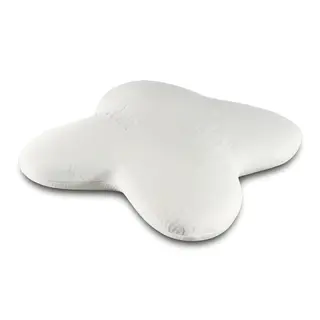
An ergonomic pillow is defined first by its shape and not by its material. It does not necessarily use viscoelastic foam (it can be natural latex or high-resilience foam). You can spot an ergonomic pillow right away by its specific cut, often like a "wave" (with two bolsters of different heights). That wave shape fills the exact gap between the neck and the mattress, keeping the spine aligned with the head.
To combine the best of both, most premium ergonomic pillows today use viscoelastic foam. In short: ergonomic pillows are usually memory foam, but the reverse is not always true (a standard square pillow in viscoelastic foam is not considered ergonomic).
Although most sleepers in France are used to a square pillow, sleep experts and physical therapists strongly recommend a rectangular pillow. Why? During the night we tend to fold, bunch, or pull a square pillow up under the shoulders. That lifts the upper back and throws the cervical vertebrae out of alignment. A rectangular pillow is the natural recommendation: it stays under the head and stops cleanly above the shoulders.
For taller people, a rectangular pillow also leaves more sleeping length, which is essential for better comfort and well-being.
| Pillow shape | Standard dimensions | Recommended use | Effect on the neck |
|---|---|---|---|
| Square (French standard) | 60x60 cm or 65x65 cm | Reading, television, resting while seated. | Fair to poor (risk of lifting the shoulders). |
| Rectangular (ergonomic) | 50x70 cm or 40x60 cm | Deep sleep (back, side). | Excellent (respects the spine's natural axis). |
| "Wave" shape | Variable (often 30x50 cm) | Chronic pain, snoring. | Optimal (orthopedic support of the cervical curve). |
Choosing the right size of ergonomic pillow is very important if you want restorative sleep. The size and shape should match your build (shoulder width). For back sleepers, a 60x60 cm model can sometimes be enough if it is flat, but for side sleepers a 50x70 cm pillow is strongly recommended. In short: use square pillows to prop yourself up during the day, and rectangular ones at night.