

$88.49In stock, ships tomorrow
Free shipping on orders over $20010% off with code WELCOME
1 products
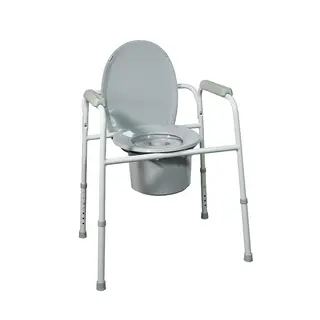
When you set up a home, making the toilet safer is one of the most important ways to prevent accidents. The classic fixed commode chair is widely recommended by occupational therapists and other healthcare professionals for two clinical reasons: full safety during a transfer and mechanical reliability. With no wheels, there is no chance of an unexpected roll, a forgotten brake, or the chair shifting when the user, sometimes weak or disoriented, leans hard on the armrests. This is the clear answer for stationary use in the bedroom.
Falls at night, on the way to the bathroom, are a leading cause of hospital stays for seniors. A stationary hygiene chair right next to the bed answers real problems that come with loss of independence:
The equipment has to match the movement the person still has. A clinical look at mobility should decide the best choice.
If a senior or patient can walk even a few difficult steps to the chair, a stationary model is the better fit. It gives the base of support people need when they have dizziness or a walking disorder (Parkinsonian syndrome, neuropathies). If the condition means a family caregiver or a professional caregiver has to move the person while seated, from the bedroom to the bathroom, choose a wheeled commode chair. That rolling design is built to spare the caregiver's back and avoid lifting that strains the lower back.
Putting a medical device in the bedroom, a private living space, can be hard to accept when independence is changing. Our fixed chairs are functional and easy to keep clinically clean, but they can look very medical (an exposed tubular metal frame). If you want something that blends into the room and still protects the person's dignity, look at our furniture-style commodes. These higher-end models, often finished in wood with a polished look, hide the hygiene bucket under a wide, padded seat. By day, the chair works as a real, comfortable place to rest.
To get a hygiene chair that matches the person's build and conditions (arthritis, hemiplegia, joint pain), look at these specs:
Armrest type plays a major role in how a transfer works. Fixed, padded armrests give a solid hold for a standard stand from the front. If the patient cannot stand and does a sideways "slide" transfer (from the edge of the bed to the chair on a "banana" transfer board), the chair needs armrests that drop back or come off completely.
| Equipment type | How firmly it stays put / safety | How far it can move | Clinical profile & recommended use |
|---|---|---|---|
| Stationary commode (standard) | Maximum (wide rubber pads) | None (stationary) | Independent or assisted transfers, people who are disoriented, strict fall prevention, longer periods of sitting. |
| Wheeled commode | Moderate (brakes must be set) | Full (4 swivel casters) | A patient who cannot walk, a safe bedroom-to-bathroom move by someone else, less physical strain on the caregiver. |
| Furniture commode chair (wood / design) | High (the chair is often heavy and stable) | None | Looks and self-esteem come first, discreet use at home, doubles as a bedroom chair and a toilet. |
A bedroom toilet needs careful hygiene to help prevent cross-infection and to keep the room healthy and free of odor. The bucket (or built-in chamber pot) is shaped to make the daily cleanup easier.