
$59.49In stock, ships tomorrow
Free shipping on orders over $20010% off with code WELCOME

Shop other styles
1 products
Movement difficulties and joint problems get in the way of many activities of daily living (ADLs), especially in the kitchen. Ordinary utensils usually need a strong grip, a precise thumb-and-index pinch, or both hands working together. To help seniors and people with disabilities stay fully independent and make everyday life easier, the sink and the cleaning tools need a more ergonomic setup. Tous Ergo offers a wide range of adaptive equipment to make these tasks safer.
You can keep your independence in the kitchen. Our occupational therapists recommend our washing accessories to help with the effects of several conditions:
In this section you will find every solution we offer for cleaning and washing while you prepare a meal and put things away. The accessories are grouped by what they mainly do:
Washing your hands is the first hygiene step in the kitchen, but pressing a standard pump bottle takes a specific kind of strength. For people with a severe or moderate grip difficulty, we offer an automatic soap dispenser. An infrared sensor does the work: place your hand under the nozzle and you get the right amount of liquid soap, with no contact and no pressing.
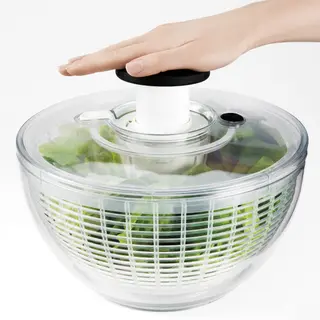
Washing vegetables or spinning salad often means hard wrist-turning motions (pronation / supination). To avoid that strain, choose a salad spinner with a pump mechanism. This design needs only a simple downward press on a wide button with the palm of your hand, which limits joint fatigue in the shoulder and elbow.
Scrubbing utensils with a sponge takes muscle endurance and good dexterity. To make the job easier, the soap-dispensing brush is a standout 2-in-1: it holds dish soap in its non-slip handle and releases it with a simple press of the thumb. For people who have to wash dishes with one hand, the glass-washing brush is essential. It stays firmly fixed to the bottom or side of the sink on a wide suction-cup base, so you can wash glasses, cups, and small bowls with a simple push-and-turn motion.
To match the product to your mobility, pay attention to these basics:
| Type of daily living aid | Main benefit | Best for (conditions / uses) | Grip type needed |
|---|---|---|---|
| Automatic dispenser | No pressing, touch-free hygiene | Parkinson's, severe osteoarthritis, rheumatoid arthritis, amputation | None (motion detection) |
| Suction-cup brush | One-handed dishwashing | Hemiplegia, arm in a cast, upper-limb amputation | Gross grip (one active hand) |
| Reservoir brush | Saves time and cuts down on handling bottles | Mild muscle weakness, finger pain | Thickened cylindrical grip |
| Pump salad spinner | Removes twisting motions of the wrist | Carpal tunnel syndrome, tendonitis, musculoskeletal disorders (MSDs) | Palm pressure (palm of the hand) |
Water and soap quickly turn the kitchen into a slippery zone, which raises the risk of household accidents for seniors. To help prevent broken dishes and injuries: